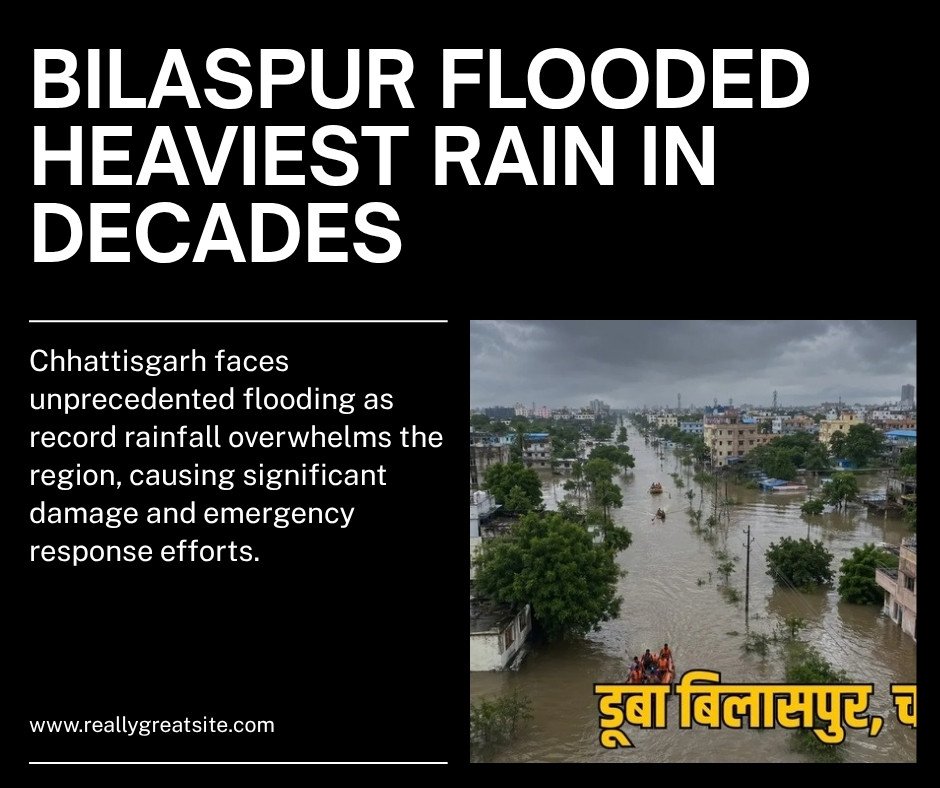
Bilaspur Records Heaviest Rain in Nearly a Century
Bilaspur, July 18 — Bilaspur woke up to a city transformed on Friday, after a night of relentless rain left main roads under four to five feet of water, submerged low-lying colonies, and forced rescue teams into round-the-clock operations. The India Meteorological Department’s bulletin dated July 17 had flagged isolated extremely heavy rainfall over Chhattisgarh, and Bilaspur bore the brunt of it — among the heaviest single-spell rainfall totals the city has measured in decades.
What happened overnight
Torrential rain that began Thursday night and continued into Friday afternoon dumped rainfall figures ranging between roughly 28 cm and over 40 cm depending on the measuring station, according to regional weather reporting. Some local accounts put the total as high as 16 inches in 24 hours — a figure that, if confirmed, would be the city’s heaviest rainfall since 1933, though that specific historical comparison has not been independently verified through an official IMD record check.
Streets in several neighbourhoods disappeared under water fast enough that residents described the change as sudden. Low-lying colonies were the worst hit, with water rising into homes overnight. The State Disaster Response Force moved through the night, and by Friday morning had rescued more than 40 people from flooded houses and stranded vehicles.
The city grinds to a halt
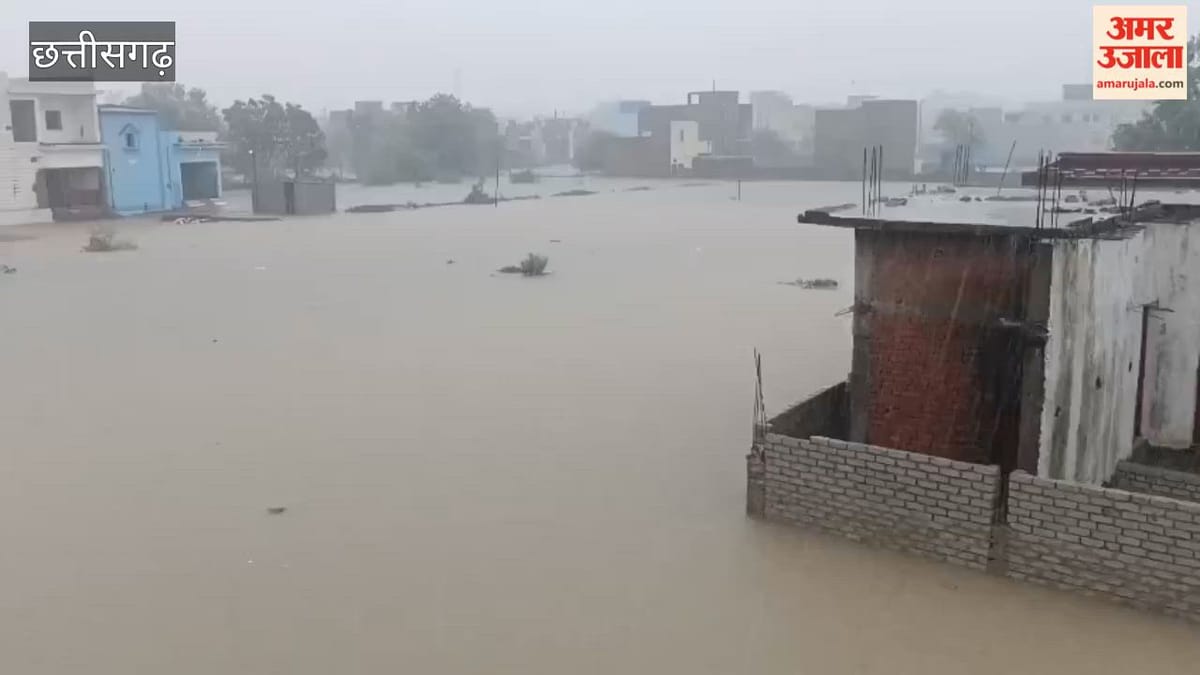 Photo: Amar Ujala.
The flooding didn’t stay contained to housing. Rail and road traffic through Bilaspur was disrupted as tracks and key routes went under water, and power was cut to a number of neighbourhoods as a safety measure once low-lying electrical infrastructure became waterlogged. District authorities ordered schools and colleges shut for the day, and issued an advisory urging residents to stay off flooded roads until water levels recede.
For a city that had been dealing with an unusually intense heat spell in the days prior, the shift to this scale of flooding within a single night has left both residents and the local administration scrambling to respond, even as the rain shows no immediate sign of easing.
Villages along the Lilagar and Shivnath rivers hit harder
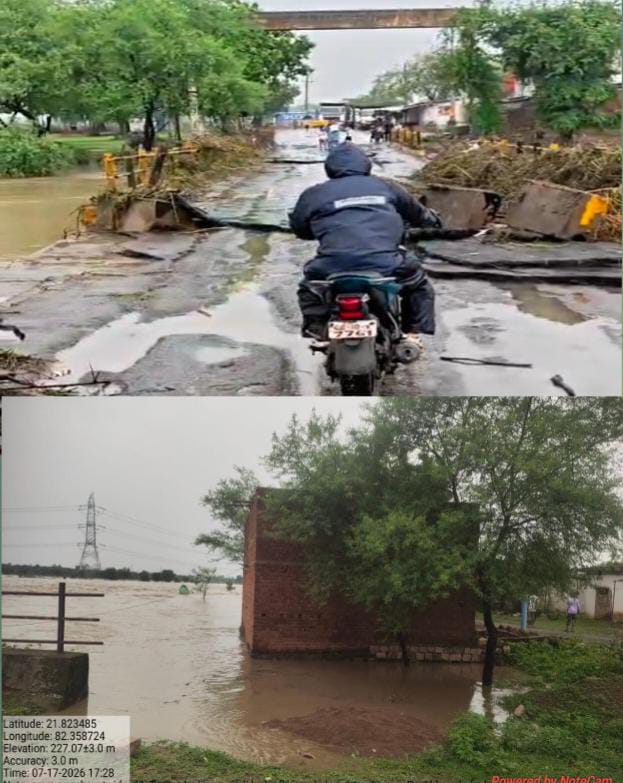
Outside the city limits, the damage has, if anything, been worse. The Lilagar river, swollen by the rain, breached its banks and sent floodwater directly into a cluster of villages in the Masturi block — Katha Bharari, Kewatadih, Tangar, Vidyadih, Bhutaha, Sonsari and Basantpur among them. The Risda Kutighat bridge, a key link connecting Janjgir-Champa to Masturi and onward into Bilaspur, sustained significant damage in the flooding, cutting off a route that residents rely on for their daily commute and trade.
Villages along the Shivnath river — including Shivtikari, Bhilauni and Amaldiha — reported a similar pattern, with both direct rainfall and river overflow pushing water into homes. For farming families in these areas, the timing is particularly harsh: standing paddy and vegetable crops in low-lying fields are now submerged, threatening a harvest many had been counting on.
Local visuals circulating on social media through the day — including footage shared from the ground in Bilaspur — showed submerged streets, waterlogged school premises, and flooded neighbourhoods, corroborating the scale of disruption described by rescue teams and residents alike.
The weather system behind it
Meteorologists attribute the sudden intensity to a burst of cumulonimbus cloud activity over the city, driven by a low-pressure system active over the Gangetic plains that pulled in unusually high moisture. Conditions of that kind can produce extremely concentrated rainfall in a short window — accounts from the ground describe roughly 150 mm falling in just two hours overnight, which is what turned steady monsoon rain into a flash-flood situation almost without warning.
Bilaspur wasn’t alone in taking on heavy rain. Janjgir recorded around 170 mm, and the state capital Raipur logged roughly 90 mm over the same 24-hour window, with several other districts across central Chhattisgarh also reporting substantial rainfall.
What comes next
The IMD’s outlook, issued July 18, points to active monsoon conditions persisting over the region for the next several days, with more rain forecast for north and central Chhattisgarh over the coming 48 hours. Authorities have repeated their advisory for residents in low-lying and riverside areas to stay alert and be ready to move to higher ground if water levels continue to climb.
For now, the immediate priority for district authorities remains rescue and relief — clearing waterlogged roads, restoring power to affected neighbourhoods, and assessing the damage to the Risda Kutighat bridge and other infrastructure before the next spell of rain arrives.
Why this matters beyond one wet night
Bilaspur’s civic infrastructure was built for a monsoon pattern that is visibly no longer the norm. A single-night rainfall event of this scale — arriving after an unusually hot, humid spell rather than as a gradual buildup — is the kind of compressed, high-intensity weather that urban drainage systems across central India have struggled to absorb in recent years. Three major sub-stations and roughly a dozen and a half transformers going under water in one night points to a power grid with limited flood buffer in low-lying zones, a vulnerability that will likely draw scrutiny once the immediate emergency response winds down.
The damage to the Risda Kutighat bridge adds a longer-tail concern: it is not just a local inconvenience but a working link between two administrative districts, and its repair timeline will shape how quickly Masturi’s flood-hit villages can access relief supplies, medical care and, eventually, normal transport in the weeks ahead. With the IMD forecasting continued heavy rain through the region, both the city’s recovery and the rural relief effort remain very much a live situation rather than a one-day event.
Sources: India Meteorological Department press bulletins dated 17-18 July 2026; State Disaster Response Force rescue operation figures; district administration order on school closures; local visuals via Instagram — reel 1, reel 2.
Leave a Reply