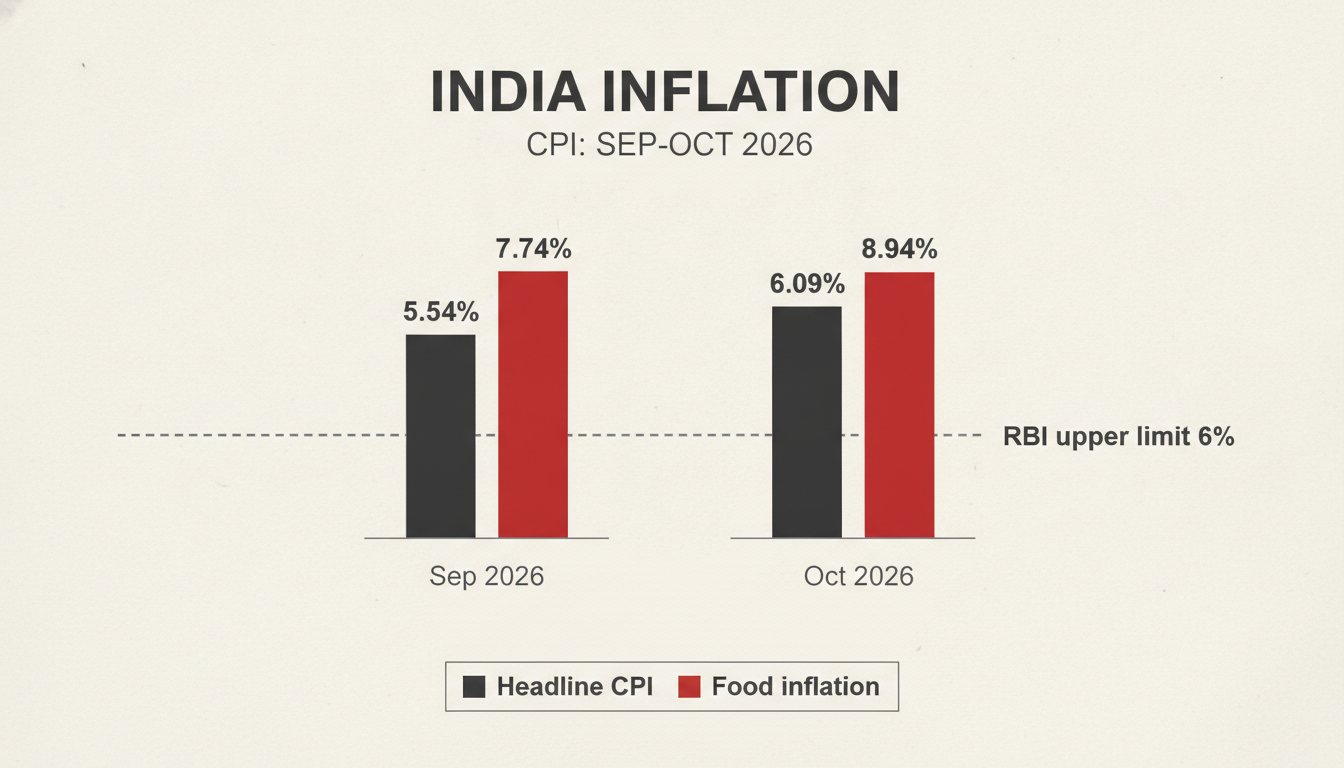
India’s retail inflation rose to 6.09 percent in October 2026, up from 5.54 percent in September, the Ministry of Statistics and Programme Implementation (MoSPI) said on November 12. The reading pushed headline inflation past the Reserve Bank of India’s upper tolerance limit of 6 percent for the first time in about two years, driven largely by a sharp rise in food prices.
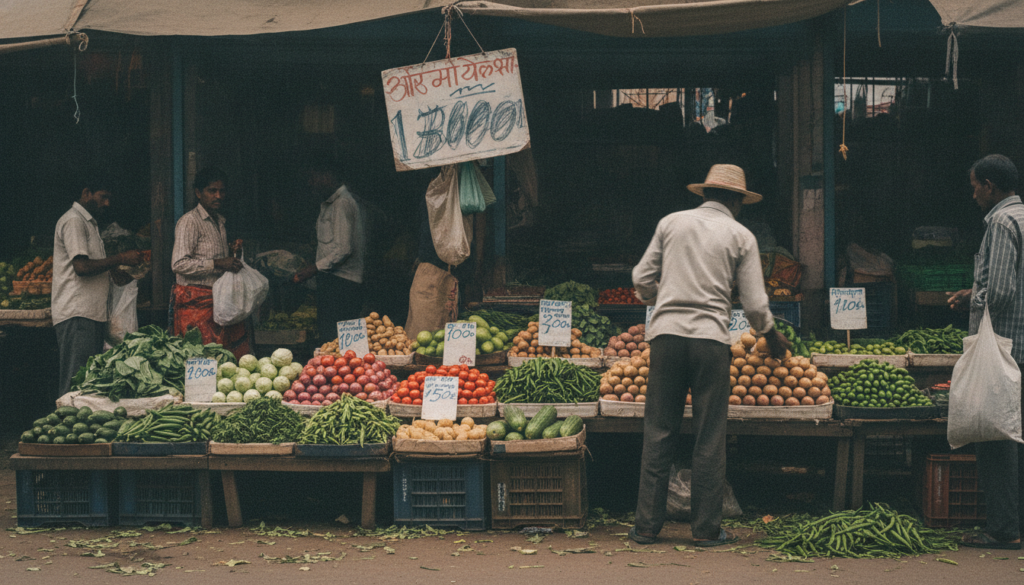
Food inflation, the single biggest driver of the October number, climbed to 8.94 percent from 7.74 percent in September, according to the same MoSPI release. Zeebiz reported that a sharp surge in onion prices was among the factors behind the jump in the food basket, though MoSPI’s release did not break out onion prices on its own.
The October print marks the first time since late 2024 that headline CPI has breached the RBI’s 6 percent ceiling, according to Xinhua, which cited the same official data later corroborated by Business Standard and Zeebiz. Under its inflation-targeting mandate, the RBI is required to keep retail inflation within a band built around a 4 percent midpoint, with 6 percent as the upper limit it is meant to defend.
What Pushed Inflation Higher in October
Food prices did most of the work. MoSPI’s release puts food inflation at 8.94 percent in October, more than a full percentage point above September’s 7.74 percent, while the headline number rose by a smaller 0.55 percentage points over the same period. That gap points to food, not fuel or core goods, as the main pressure point.
Vegetables were a visible part of that pressure. Zeebiz reported a sharp spike in onion prices specifically, a staple that tends to move retail food inflation quickly when supply tightens, though the scale of that single item’s contribution to the overall 8.94 percent figure was not broken out in the official release.
The Consumer Price Index that MoSPI publishes each month tracks a fixed basket of goods and services, split broadly into food and beverages, fuel and light, housing, and a set of other goods and services sometimes grouped as “core” inflation. Because food and vegetables carry a heavy weight in that basket and are also the most volatile component month to month, a swing in vegetable or pulses prices can move the headline number faster than a change in fuel or manufactured-goods prices would.
September vs October, Side by Side
| Metric | September 2026 | October 2026 |
|---|---|---|
| Headline CPI inflation | 5.54% | 6.09% |
| Food inflation | 7.74% | 8.94% |
| RBI upper tolerance limit | 6% | 6% |
The climb has been building for three straight months. Headline CPI inflation stood at 4.83 percent in August, rose to 5.54 percent in September, and has now reached 6.09 percent in October, per MoSPI’s own month-on-month releases. That trajectory took inflation from comfortably inside the RBI’s band to above its ceiling in a single quarter.
What It Means for RBI Policy
The RBI’s monetary policy committee (MPC) sets the benchmark repo rate with an eye on keeping inflation inside its target band, so a breach of the upper limit narrows the central bank’s room to cut rates further. The committee typically reviews policy every two months, and its next scheduled review will be the first chance for it to respond formally to the October data.
MoSPI’s release did not include any RBI statement reacting to the October number, and none has been issued separately as of this writing. A single month above the upper limit does not automatically trigger a policy response under the inflation-targeting framework; the RBI is required to explain itself to the government only if inflation stays outside the 2-6 percent band for three consecutive quarters. Whether this becomes that kind of sustained breach, or a one-month spike that eases once vegetable supply normalises, will depend on November’s reading.
Frequently Asked Questions
What is the RBI’s inflation tolerance band?
The Reserve Bank of India operates under a flexible inflation-targeting framework built around a 4 percent midpoint, with 6 percent as the upper limit and 2 percent as the lower limit it is required to defend.
When did headline inflation last breach this limit?
According to Xinhua’s reporting of the MoSPI data, October 2026 is the first time since late 2024 that headline CPI has crossed above the RBI’s 6 percent ceiling.
Does one month above the limit force the RBI to act immediately?
No. Under the inflation-targeting framework, the RBI is required to formally explain itself to the central government only if inflation stays outside the 2-6 percent band for three consecutive quarters, not after a single month’s reading.
What happens next depends on whether food prices, and vegetable prices in particular, ease in November’s reading, and on how the RBI’s monetary policy committee responds when it next meets.
Leave a Reply