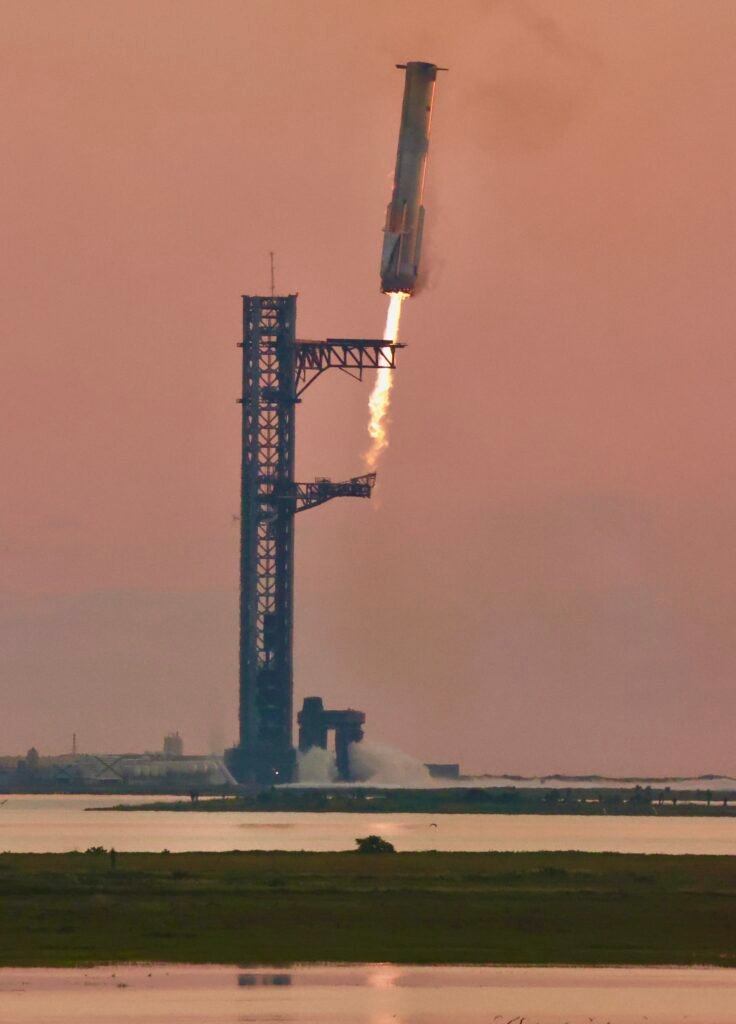
SpaceX caught its Starship upper stage with the mechanical arms of its Starbase, Texas launch tower on Saturday, after the vehicle completed roughly 14 orbits of Earth, the first time any company has returned an orbital rocket’s upper stage to its launch site and caught it. The attempt to catch the mission’s Super Heavy booster failed; it aborted itself mid-flight and came down in the Gulf of Mexico.
What happened on Flight 15
Starship Flight 15 lifted off from Pad 2 at Starbase at 4:45 p.m. Central Time on Friday, November 13, carrying Ship 42 atop Booster 22, according to Teslarati. It was SpaceX’s first attempt to catch both the booster and the upper stage on the same flight.
Ship 42 reached orbit, deployed 26 Starlink V3 satellites, and circled Earth about 14 times before reentry. Three of the deployed satellites carried cameras to image the ship’s heat shield in orbit; SpaceX said those images showed the shield was in good condition ahead of reentry. Roughly 22.5 hours after liftoff, the ship returned to Starbase and was caught by the tower’s chopstick-style arms, known as Mechazilla, according to CNBC.
Why the booster catch failed
Booster 22 did not return to the tower. SpaceX said on X before the catch window that “pad and tower systems are go for catch,” but the booster aborted itself during the later stages of its coast phase due to a guidance, navigation, and control issue. SpaceX’s Dan Huot said: “We were initially go for a catch, but in the later stages of the coast, the booster aborted itself.”
The booster’s flight termination system triggered and it came down in the Gulf of Mexico. Elon Musk said on X that the loss traced to Raptor engines that slightly underperformed, leaving the booster short on propellant margin. He said the fix is improved consistency in SpaceX’s Raptor V3.2 engines along with a software change to cut engine burns “about one second earlier.” Musk added: “This booster loss does not change our timeline to reach high volume, fully reusable Starship flights.”
Airspace disruptions during the flight window
Hawaii’s Department of Transportation briefly paused some West Coast flights over debris risk tied to the launch window, and the FAA separately issued a nationwide ground stop around the same period due to unrelated telecommunications failures, as Praman reported in its earlier coverage of the ground stop’s cause. Both orders have since been lifted, and CNBC’s report treats the two events as separate and unconnected.
Why this milestone matters
Super Heavy boosters have now been caught three times since October 2024, most recently in March 2025, but every previous Starship upper stage had either splashed down in the ocean or been lost, including a September 2025 flight that reached orbit but ended in a Pacific splashdown after about three hours. Saturday’s catch is the first time the ship itself has come home to the tower.
A fully reusable Starship is central to SpaceX’s near-term and long-term plans. CNBC reports that Starship is needed to keep deploying Starlink V3 satellites, which the network depends on for its current revenue, with more than 11,000 satellites already in low Earth orbit and a single Starship capable of carrying up to 60 Starlink V3 satellites per flight. Teslarati reports that reusable ships also matter for SpaceX’s planned Starmind orbital compute constellation and for NASA’s Artemis lunar lander program, which depends on Starship being refueled in orbit, something that in turn depends on the vehicle being reusable.
Frequently asked questions
What does it mean to “catch” a Starship?
Instead of landing on legs or splashing down in the ocean, SpaceX’s launch tower at Starbase uses two mechanical arms, nicknamed Mechazilla or “chopsticks,” to grab the returning vehicle directly out of the air as it descends, avoiding the weight and complexity of landing legs.
Has SpaceX caught a Starship before?
SpaceX had caught the Super Heavy booster three times before this flight, most recently in March 2025. Saturday’s flight was the first time the Starship upper stage itself, which flies to orbit, was caught after returning to the tower.
What happened to the booster this time?
Booster 22 aborted its own catch attempt during the coast phase after a guidance issue, and its flight termination system brought it down in the Gulf of Mexico. Musk attributed the loss to underperforming Raptor engines and said SpaceX is addressing it with engine consistency improvements and an earlier engine cutoff.
Leave a Reply