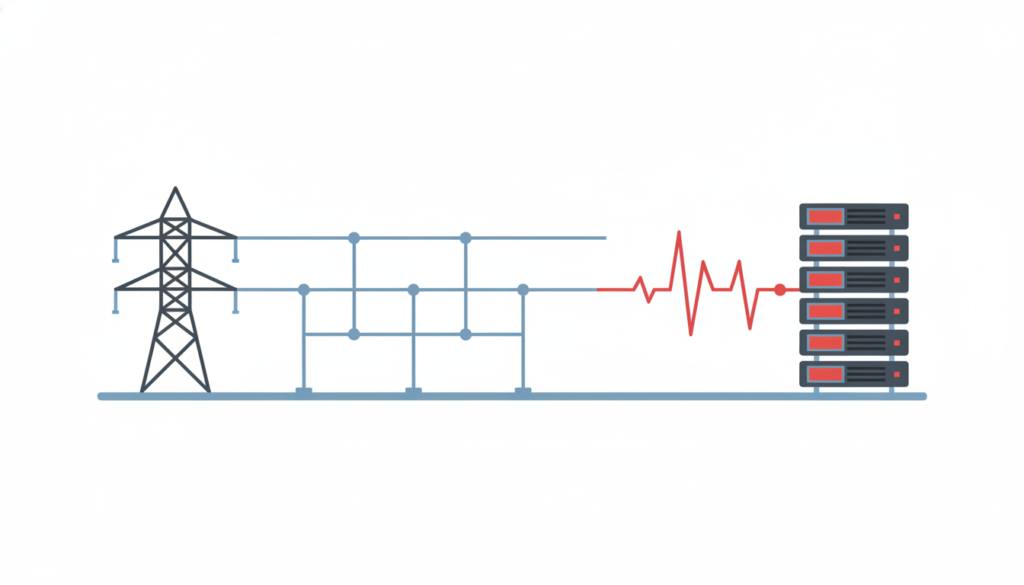
Researchers in Germany have traced a years-long mystery, brief power grid frequency dips occurring at the same moment on grids across different continents, to data center backup batteries and uninterruptible power supplies that check their charge level once every minute, according to TechCrunch. The finding is published in Nature Energy (DOI 10.1038/s41560-026-02144-0).
What the researchers found
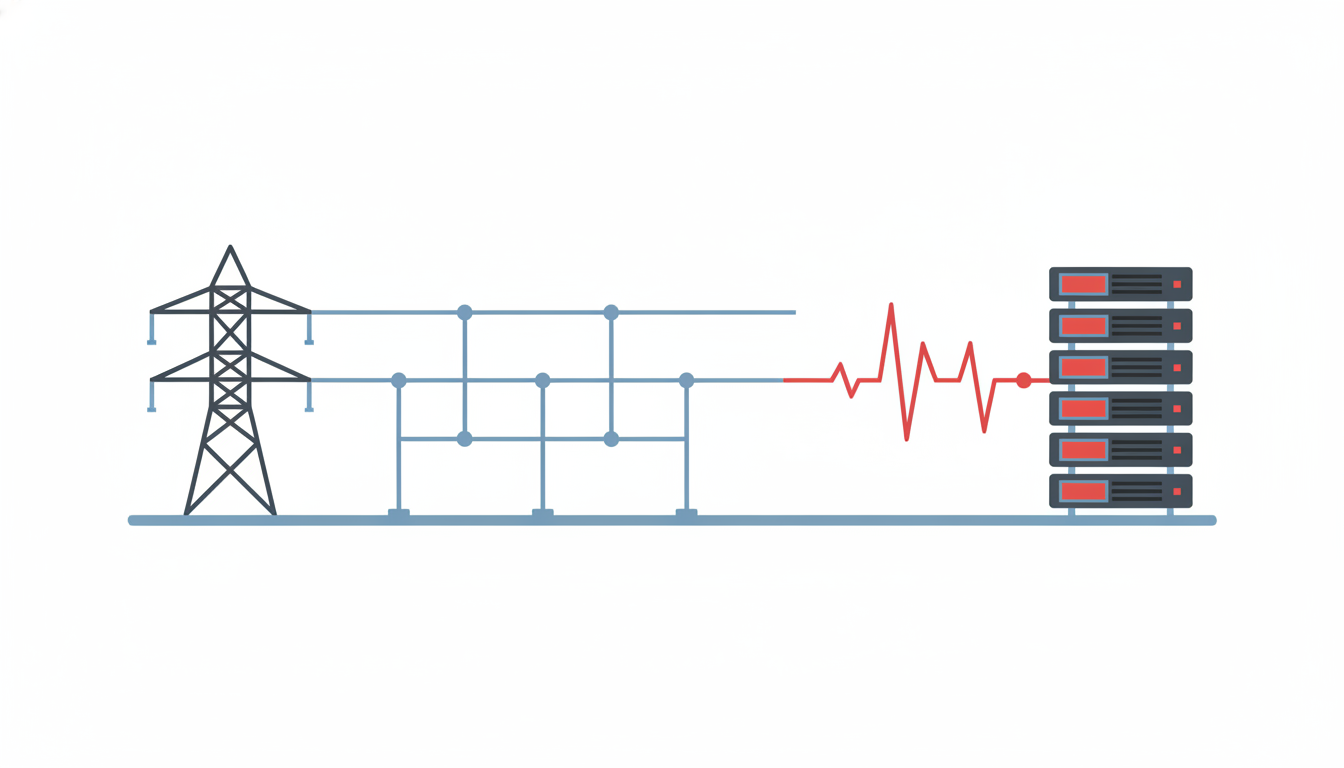
Grid frequency on power systems in Europe, Australia, the United States and Malaysia has been dipping briefly about once every minute, with the dips occurring at the same moment across countries and continents. Germany’s largest transmission system operator, TenneT, brought the pattern to Dirk Witthaut, a researcher at Forschungszentrum Julich, after it kept showing up in grid data.
Witthaut’s team first suspected resonance in hydropower turbine control systems, since a model of a hydropower system on the Scandinavian grid could produce a similar effect. That model did not explain a disturbance that repeated minute after minute, so the team installed more than 80 smart power quality meters across the Julich campus, sampling every three seconds.
A transformer connected to a battery energy storage system showed a spike every minute, pointing the investigation toward batteries and backup power equipment rather than large turbines.
Why data centers are behind it
Uninterruptible power supplies and stationary batteries, including the kind used in data centers and large grid-scale battery installations, check their state of charge once every minute. Because these are internet-connected devices running near-identical clocks, their checks land at the same moment, and the combined effect becomes visible as a dip on the wider grid.
Data centers made up 18 percent of Ireland’s grid load by 2022, and each facility is typically served by many individual UPS units, multiplying the synchronized effect. The researchers also tested consumer and industrial IoT devices, including a smart oven and clusters of Raspberry Pi computers, and found similar periodic fluctuations from those too.
The finding lands in the middle of a global data center construction wave driven by AI infrastructure spending. Google confirmed a 17 billion dollar investment in a new Wyoming data center earlier this month, Praman reported on November 8, and Meta’s own president has warned separately that growing local backlash against new sites could slow further expansion. Each new facility adds more of the exact equipment, UPSs and grid-scale batteries, that the Julich team identified as the source of the synchronized dips.
How much the disturbance has grown
Ireland’s grid data shows the minute-by-minute frequency drop has grown substantially over the past decade, as data center load on the Irish grid has expanded.
| Year | Minute-by-minute frequency drop (Ireland) |
|---|---|
| 2016 | 3 millihertz |
| 2021 | 12 millihertz |
| Recent readings | Above 20 millihertz in some cases |
Ireland’s 50 Hz grid can tolerate frequency swings of plus or minus 200 millihertz, though its operator prefers to keep fluctuations within 100 millihertz. The researchers warn the repeated dips can damage equipment, particularly hydropower turbines, and could add to blackout risk when combined with other sources of grid stress.
The researchers’ early hypothesis, resonance in hydropower turbine control systems, turned out to be a dead end on its own, but the concern about turbine damage remains relevant for a different reason: repeated minute-by-minute mechanical stress from the dips, even if not caused by turbines themselves, lands on the same hydropower equipment the team initially suspected.
What would fix it
The researchers describe the problem as entirely preventable. Their recommended fix for UPS and grid-scale battery manufacturers is to randomize exactly when a device checks its state of charge, rather than checking precisely on the minute mark.
For IoT devices, the fix is a firmware update, though TechCrunch cites a study finding that fewer than 3 percent of IoT devices run the latest firmware, which complicates how quickly that fix could spread in practice. The paper’s authors say global coordination between manufacturers and regulators will be needed to apply the fix broadly.
Frequently asked questions
Is this a safety risk to the power grid right now?
The researchers say the dips alone have not caused blackouts, but warn they can damage equipment such as hydropower turbines and could contribute to blackouts when combined with other grid stress.
Which devices are responsible?
Uninterruptible power supplies and stationary batteries, particularly those used by data centers and grid-scale battery storage systems, along with some internet-connected IoT devices.
Has any manufacturer or regulator responded?
TechCrunch’s report does not include a direct statement from TenneT, Forschungszentrum Julich, device manufacturers or a regulator beyond the researchers’ own recommendation.
What to watch next
Whether grid operators or equipment manufacturers respond with the randomization fix the researchers recommend, and whether regulators in major data center markets take up the coordination the paper calls for, will determine how quickly the pattern fades from global grid data.
Leave a Reply