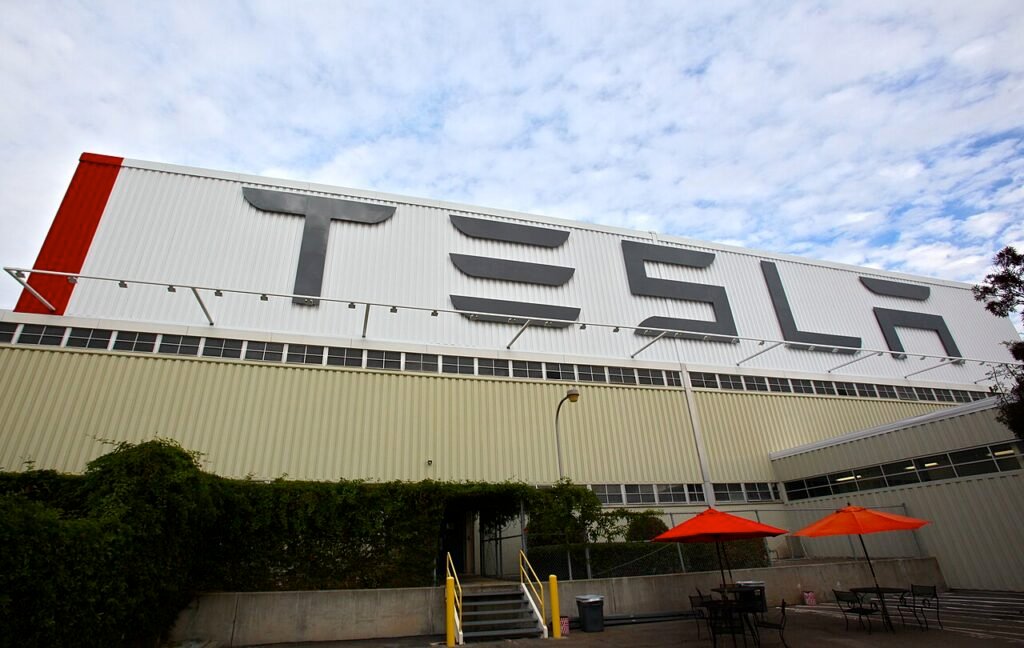
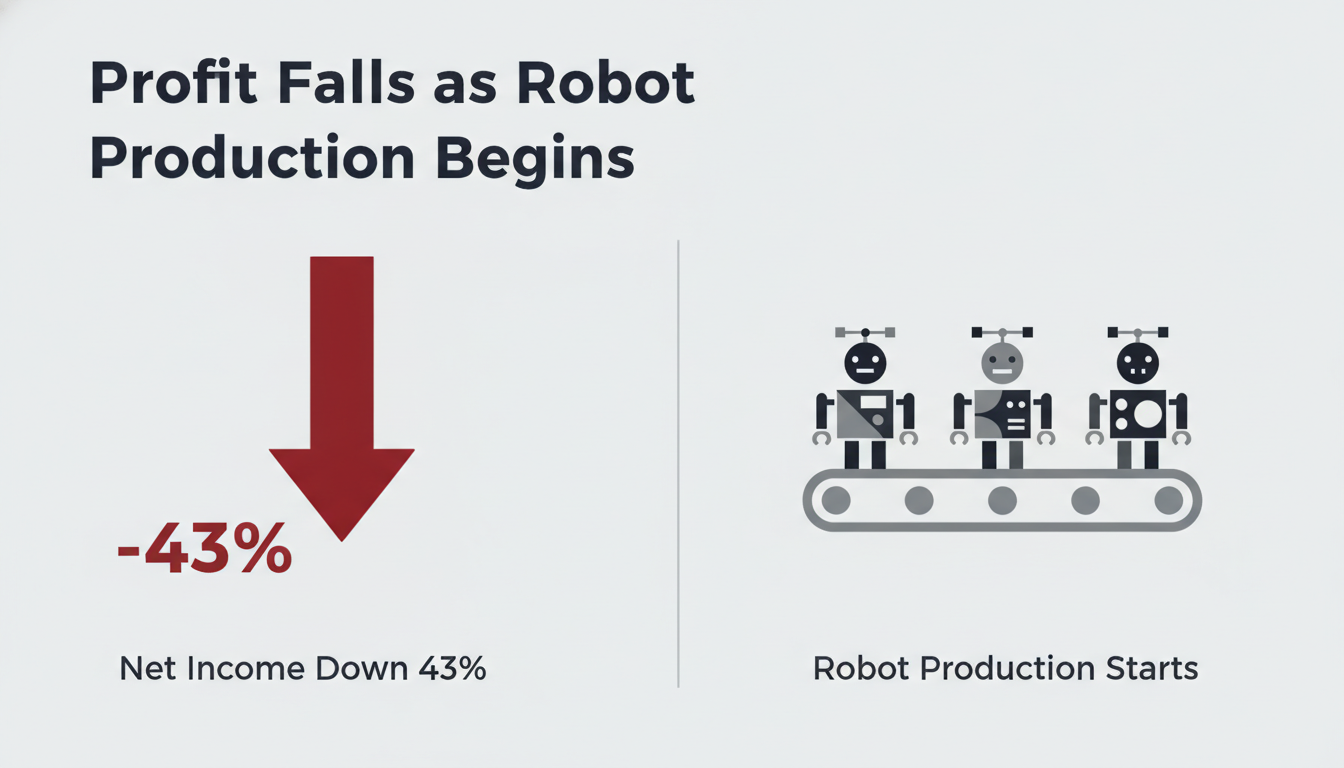
Tesla has started producing its Optimus humanoid robot at its Fremont, California factory, even as the company’s quarterly profit fell 43 percent. Tesla disclosed both in its third-quarter 2026 shareholder letter and earnings call on October 21, 2026.
What did Tesla announce about Optimus?
Tesla said it has begun producing its Optimus humanoid robot inside a section of its Fremont factory once used for electric vehicle manufacturing. In its shareholder letter, reported by TechCrunch, Tesla described these as “the first production-quality bots that we have manufactured.”
On the earnings call, chief executive Elon Musk called the current stage “early production” and said the ramp-up would be slow and uneven because of how new the product is. He said the design still needs changes before Optimus can reliably handle open-ended tasks, and that meaningful AI work remains before that happens. Musk still projected Tesla would reach a run rate of 20,000 robots a week by the end of 2027.
That 20,000-a-week target would represent a large scale-up from the handful of units Tesla has shown off in demonstrations over the past two years. Musk has repeatedly pushed back his own timelines for Optimus since first unveiling a working prototype in 2022, and Wednesday’s call was the first time the company confirmed actual production-line manufacturing rather than hand-built demo units.
How did Tesla’s finances look in the third quarter?
Tesla’s net income fell 43 percent to 787 million US dollars in the third quarter of 2026, down from 1.37 billion US dollars a year earlier. Total revenue was roughly flat at 28.04 billion US dollars, against 28.09 billion US dollars in the same quarter of 2025.
Tesla delivered 486,532 vehicles in the quarter, about 6,000 more than the previous quarter but fewer than a year earlier, and EV sales revenue held flat year over year at 20 billion US dollars. Energy and solar revenue fell 16 percent year over year to 2.8 billion US dollars, which Tesla attributed to tariff-related customer refunds. Services revenue was a bright spot, up 33 percent year over year to 4.6 billion US dollars, with a record 734 million US dollars in gross profit.
The delivery number of 486,532 vehicles came in about 6,000 units above the previous quarter, suggesting Tesla worked down existing inventory rather than ramping up fresh production. Even so, that figure trailed the equivalent quarter a year earlier, underlining that core vehicle demand has not returned to its prior growth pace even as the company pours resources into robotics and autonomy.
| Metric | Q3 2025 | Q3 2026 |
|---|---|---|
| Net income | $1.37 billion | $787 million (-43%) |
| Total revenue | $28.09 billion | $28.04 billion |
| Energy and solar revenue | Baseline | $2.8 billion (-16% YoY) |
| Services revenue | Baseline | $4.6 billion (+33% YoY) |
Why did profit fall despite flat revenue?
Tesla’s own call attributed the profit drop to lower regulatory credit sales and rising spending on AI, Optimus, and autonomous driving development, all weighing on margins even as revenue held roughly steady. The weaker energy and solar segment, pulled down by tariff-related refunds to customers, added further pressure.
Regulatory credits, which Tesla earns by selling emissions credits to other automakers that fall short of clean-vehicle targets, have been a significant contributor to past quarterly profits. A decline in that income stream removes a cushion that previously offset lower margins on vehicle sales themselves, making the underlying vehicle business’s performance more visible in the headline profit number.
What did Tesla say about self-driving?
Ashok Elluswamy, Tesla’s vice president of AI software, said on the call that the company expects to turn on unsupervised Full Self-Driving for some of the first customer vehicles around the second quarter of 2027. That is a slip from Musk’s earlier statement in April, when he said the unsupervised version would probably arrive in the fourth quarter of 2026. The repeated delay echoes a pattern across Tesla’s timelines for both Full Self-Driving and Optimus, where initial target dates have consistently moved later as the underlying engineering work proved harder than first stated.
Frequently asked questions
How much did Tesla’s profit fall?
Net income fell 43 percent year over year, to 787 million US dollars from 1.37 billion US dollars in the third quarter of 2025.
Where is Tesla making the Optimus robot?
At its Fremont, California factory, in a section previously used for electric vehicle production.
When will unsupervised Full Self-Driving be available?
Tesla’s VP of AI software said around the second quarter of 2027 for the first customer vehicles, later than Musk’s earlier fourth-quarter 2026 projection.
How many Optimus robots does Tesla plan to build?
Musk projected a run rate of 20,000 robots a week by the end of 2027, though he described the current stage as early, slow-ramping production.


Leave a Reply