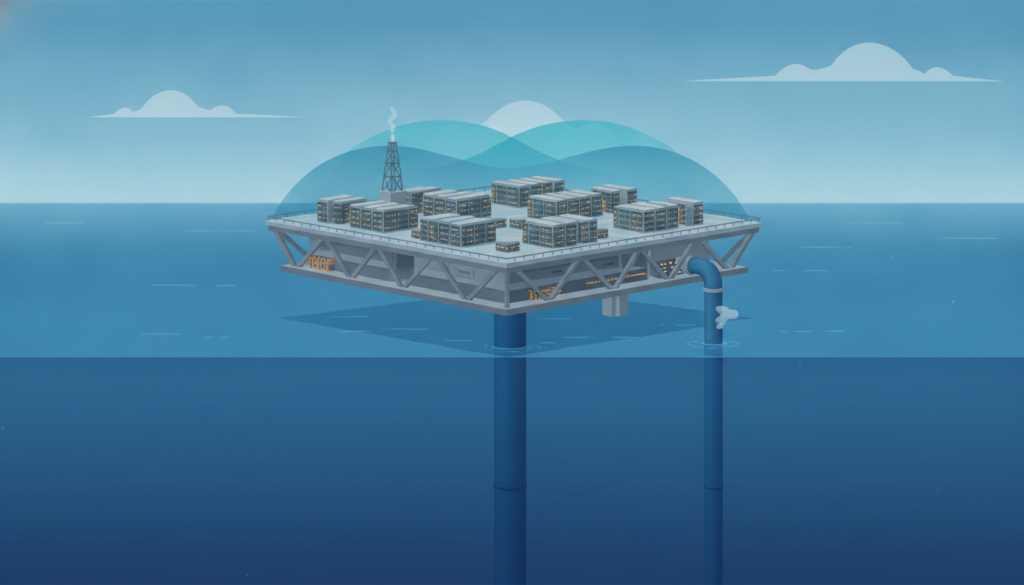
Washington, D.C. startup Drogue has raised $20 million to build data centers that float at sea and run on power generated from the temperature difference between warm surface water and cold deep ocean water. The round was disclosed exclusively to TechCrunch.
How the technology works
Drogue’s system uses ocean thermal energy conversion, a process that pulls cold water from roughly 1,000 meters below the surface to condense ammonia in a sealed loop, driving a turbine. Warm surface water doubles as a coolant for the servers themselves, according to TechCrunch.
The approach is not new. Ocean thermal energy conversion was first developed in the 1950s and tested in the 1980s before the idea was abandoned. Drogue is reviving it specifically to meet AI data center demand that founder and chief executive Sam Sipe argues land-based power grids cannot keep up with.
Why the founder says this is needed
Sipe, a former U.S. Navy E-2D Hawkeye pilot, said: “AI demand has increased 10x in just the last three years. It’s completely incompatible.” He was referring to the mismatch between AI’s growth rate and the 8 to 10 year timelines data center developers typically plan around for new power connections.
TechCrunch’s report cites oceans absorbing roughly 5.8 million terawatt-hours of additional energy every year from warming, against global human energy use of about 180,000 terawatt-hours annually, as the scale of untapped thermal energy Drogue is aiming to draw from.
Funding and timeline
The $20 million round includes XYZ Venture Capital, Toyota Ventures, Tamarack Global, Dream, FDVC, Garuda Ventures, Flexcap, Boost VC, and Slow Ventures. Drogue was founded about six months before the report and has already secured “approval in principle” from the American Bureau of Shipping, a ship classification society, and is in the process of buying its first vessel.
The company plans to test a multi-megawatt prototype on a traditional oceangoing ship starting in early 2028. Later versions would use floating structures resembling offshore oil platforms, with each vessel intended to operate at sea for roughly a decade.
Leave a Reply