
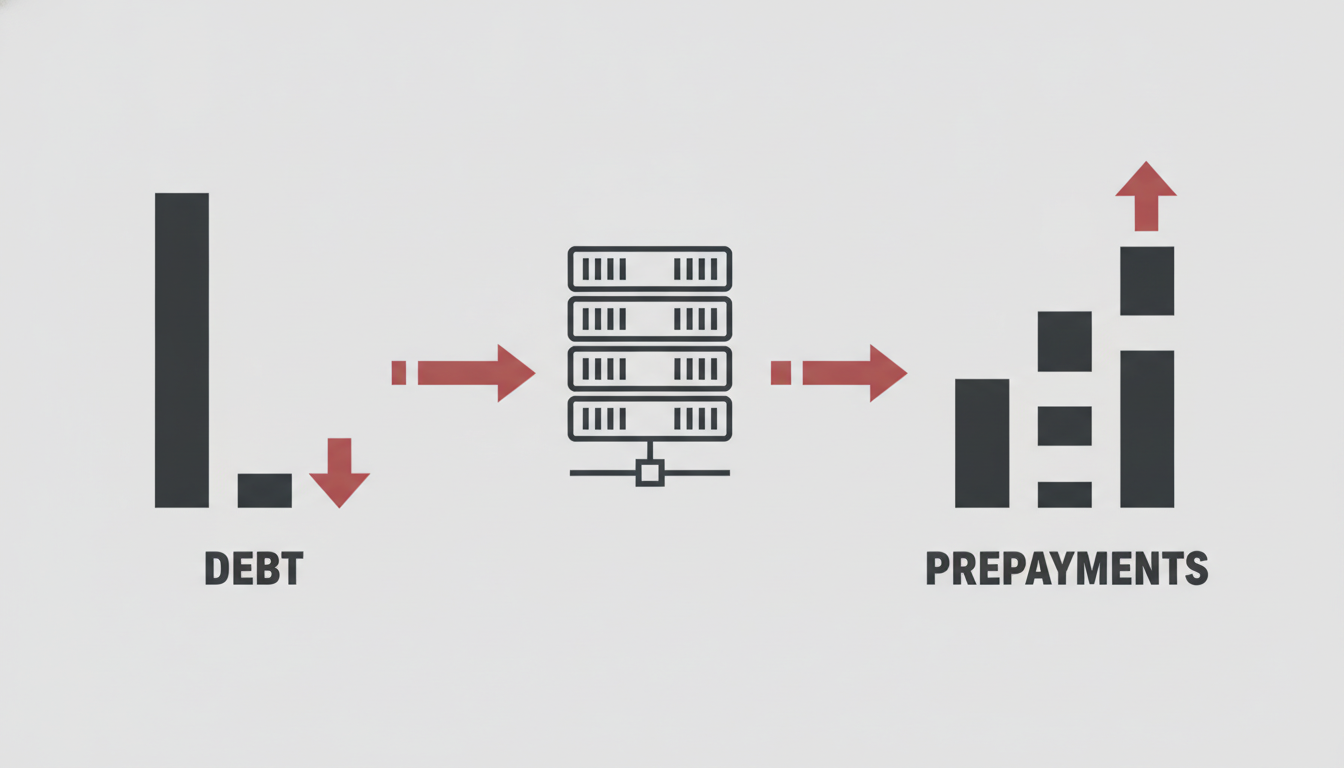
CoreWeave is asking customers to pay upfront and borrowing against individual contracts instead of relying on unsecured debt, the AI cloud company said on its Q3 2026 earnings call on November 10. The shift follows a quarter in which its interest expense hit $846 million.
What CoreWeave is changing about how it funds AI infrastructure
CoreWeave builds and rents out the GPU-packed data centers that power AI labs’ model training and inference. Historically it has leaned on debt markets to fund that buildout. On the November 10 earnings call, chief executive Michael Intrator said that approach is changing: “We will not use the unsecured debt market to fund our business at current yields, nor do we need to.”
Instead, the company is asking customers to pay deposits upfront and is borrowing against specific, already-signed contracts rather than issuing unsecured corporate bonds. It expects roughly $9 billion in customer prepayments and deposits over the next three months, more than $3 billion of which is tied to new contracts for capacity it has already built, according to its Q3 2026 earnings release reported by TechCrunch.
The numbers behind the shift
CoreWeave’s Q3 2026 revenue reached $3.66 billion, up 168% year over year, with a backlog of $132.5 billion. But the quarter also brought a $709 million net loss and that $846 million interest bill. In August the company closed a $2.6 billion loan designed specifically around shorter-term customer contracts, which it can draw down in installments rather than all at once.
| Metric | Q3 2026 figure |
|---|---|
| Revenue | $3.66 billion (+168% YoY) |
| Net loss | $709 million |
| Quarterly interest expense | $846 million |
| Backlog | $132.5 billion |
| Expected prepayments and deposits (next 3 months) | ~$9 billion |
Why shorter contracts mean higher prices
Short-term capacity now sells for more than $40 million per megawatt annually, against $20 million to $25 million per megawatt for four- and five-year contracts on new infrastructure, per the earnings disclosures. CoreWeave raised prices roughly 25% in July and another 10% later in the quarter. Pursuing shorter, pricier contracts gives the company more pricing flexibility, but it also means leaning more heavily on demand that keeps rising rather than on long, predictable commitments that lenders generally prefer.
Some of CoreWeave’s bond yields climbed above 15% last month, a sign that bond investors have grown wary of lending against data center buildouts that have not yet generated matching returns. Shifting toward customer-funded, contract-backed financing is one way CoreWeave can keep building without testing that market further.
What could go wrong with this approach
Locking in prices from upfront customer payments could look less attractive if AI compute demand keeps climbing, since CoreWeave would be collecting today’s rates rather than tomorrow’s. The strategy also adds exposure to contract renewals and pricing risk, and depends on AI compute demand that has not yet been tested through a full economic cycle.
How this compares with the rest of the AI infrastructure industry
CoreWeave is one of several so-called neocloud companies, firms that buy or lease GPU capacity and rent it to AI labs, that have taken on heavy debt to fund data center construction ahead of signed demand. Rising bond yields across the sector have made that unsecured-debt model more expensive industry-wide, which is part of why CoreWeave’s shift toward prepayments and contract-backed loans is being watched closely by investors in comparable companies, not just CoreWeave’s own shareholders.
The company’s footprint has still grown fast under the old model. CoreWeave has disclosed dozens of data centers in service and gigawatts of contracted power, built largely on the strength of multi-year commitments from AI labs that need guaranteed compute capacity. The new financing approach does not change that backlog of $132.5 billion in signed business. It changes how CoreWeave pays for the infrastructure needed to deliver on it.
Frequently asked questions
Is CoreWeave in financial trouble?
Its Q3 2026 revenue of $3.66 billion grew 168% year over year and its backlog stands at $132.5 billion, but it also posted a $709 million net loss and an $846 million quarterly interest bill. The financing shift is a response to rising borrowing costs, not a sign the backlog itself is shrinking.
Does this mean CoreWeave customers will pay more?
Short-term capacity already costs more per megawatt than long-term contracts, at above $40 million versus $20 million to $25 million annually. Customers who prepay or sign shorter deals are effectively trading predictability for the flexibility CoreWeave is building into its own balance sheet.
Leave a Reply