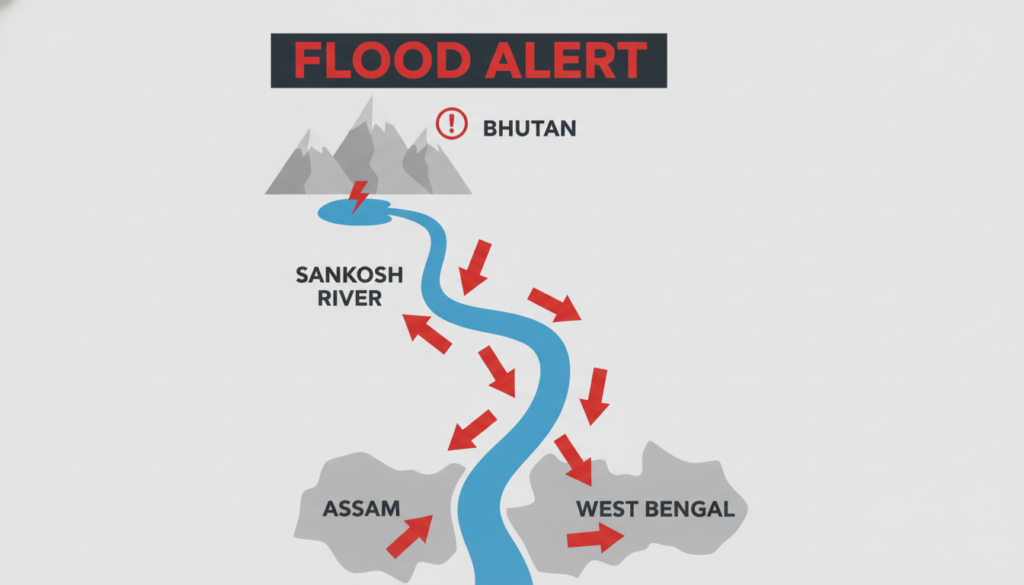
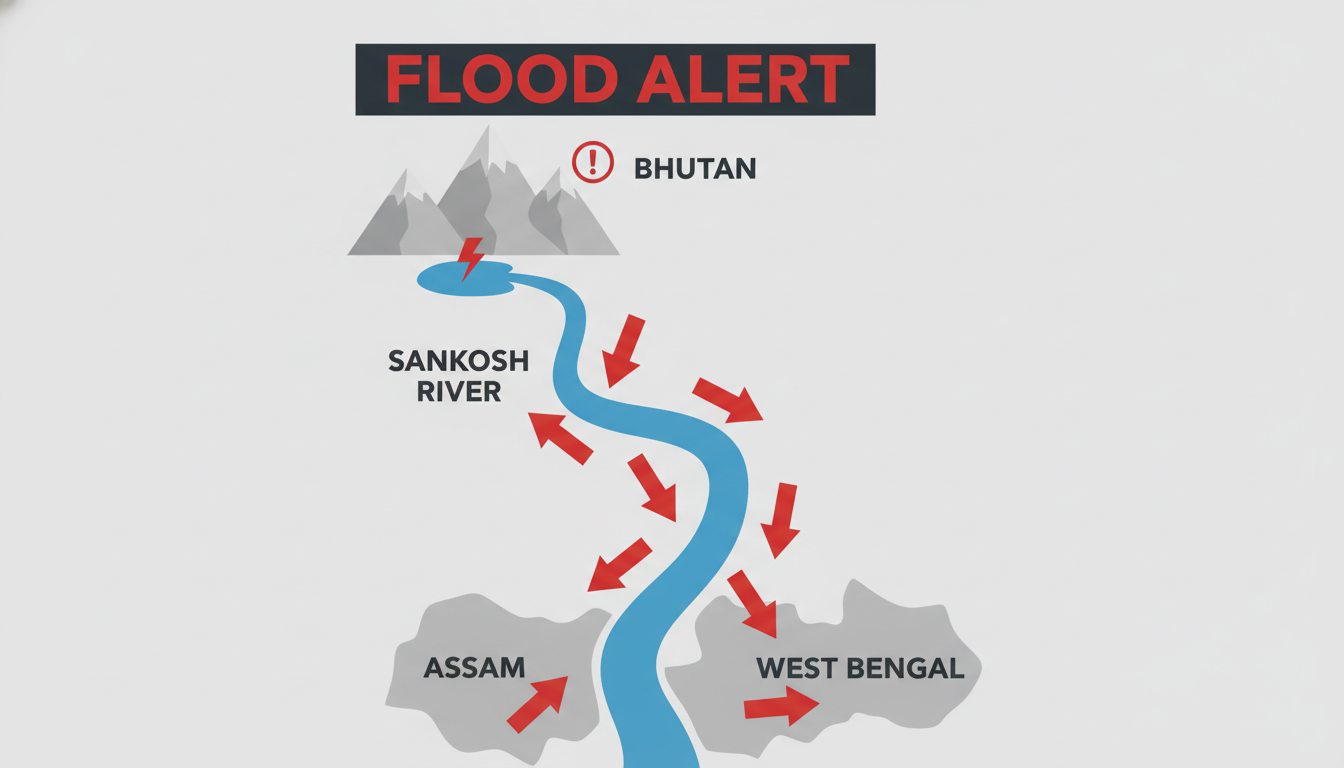
A glacial lake outburst at Sintaphu lake in Bhutan’s Gasa district on Thursday evening sent floodwater toward the India border, triggering flood alerts and evacuation advisories along the Sankosh river in Assam and West Bengal. No casualties have been reported on either side of the border so far.
What happened at Sintaphu lake
The outburst occurred near Wakila mountain in Lungo, Laya Gewog, in Bhutan’s northern Gasa district, The Shillong Times reported. The sudden release of water swept away the Gasa Tshachu hot spring complex and damaged a stretch of the Punakha-Gasa highway, Bhutan’s main link to the area.
Bhutanese authorities evacuated people from exposed locations before the surge arrived, which is why no deaths or injuries were recorded, according to EastMojo. The lake water flows into the Mo Chhu, which joins the Pho Chhu at Punakha to form the Punatsangchhu. That river crosses into India as the Sankosh.
Which districts in India are on alert
The Central Water Commission issued a special flood advisory asking Assam and West Bengal to monitor the Sankosh closely, EastMojo reported, warning of a sudden rise in water levels in Alipurduar and Dhubri. In West Bengal, the alert covers Cooch Behar, Tufanganj and Alipurduar districts along the Sankosh and its tributaries. In Assam, settlements along the Brahmaputra were told to stay alert, with Dhubri and Kokrajhar districts under watch.
Residents near tea gardens and riverbeds in northern West Bengal were asked to evacuate immediately, West Bengal Water Resources Minister Nisith Pramanik said, as reported by Scroll.in. Families from low-lying areas along the Sankosh moved to relief camps set up in north Bengal overnight, with some returning home by Friday as the water level eased. Assam Chief Minister Himanta Biswa Sarma said state teams were coordinating with the National Disaster Response Force and other agencies, and told residents to stay alert, follow official updates and cooperate with local officials
.
What officials are saying now
Amit Kumar Shaw, Superintendent of Police in Alipurduar, said water flow in the Sankosh had eased slightly by Friday but that a red alert remained in force for the river system, according to Scroll.in. He said there was no immediate need to panic, though riverside residents were asked to stay away from the banks until the alert is lifted. Bhutanese authorities said they are still assessing the full extent of the damage near Gasa and have deployed monitoring equipment upstream.
Why a Bhutan glacial lake carries risk for India
Sintaphu is one of 17 glacial lakes in Bhutan that the country’s weather agency classifies as potentially dangerous. The lake saw a sudden rise in water in August 2021 that pushed the Mo Chhu out of its usual course, so Thursday’s outburst was not its first warning sign.
The alert comes two months after a glacial lake outburst flood in Nepal killed about 1,500 people, injured more than 9,200 and left roughly 5,000 missing, a scale of damage that has sharpened concern across the Himalayan region this year. Sikkim alone has close to 700 glacial lakes, 21 of them flagged as potentially dangerous, and glacial lakes in Himachal Pradesh have grown by more than 500 percent since 1990, underlining why Thursday’s event is being watched closely rather than dismissed as routine monsoon-season flooding.
A recurring risk from upstream
Bhutan-origin floods have reached Assam before. A 2004 breach of the Tsatichu lake, formed roughly 30 km upstream of the Kurichu hydel project, sent excess water into the Manas and Beki rivers, both Brahmaputra tributaries, causing flooding downstream in Assam. Assam’s government has separately put districts on alert in past years when Bhutan released excess water from the Kurichhu dam during the monsoon, a routine precaution rather than an emergency, unlike Thursday’s sudden, unplanned outburst.
The Punatsangchhu river that carries Sintaphu’s floodwater toward India also runs past the site of the Punatsangchhu-I hydropower project, a joint Bhutan-India venture. Neither Scroll.in nor EastMojo reported any damage to hydropower infrastructure from Thursday’s outburst, and Bhutanese authorities said their assessment of the Gasa damage is still underway.
Frequently asked questions
What is a glacial lake outburst flood?
It happens when a lake formed by melting glacier ice breaches its natural dam of ice, moraine or rock, releasing a sudden surge of water downstream, as happened at Sintaphu lake on Thursday.
Which Indian states are affected right now?
Parts of Alipurduar, Cooch Behar and Tufanganj in West Bengal, and Dhubri and Kokrajhar in Assam, are under flood advisories along the Sankosh river and its tributaries.
Were there any deaths?
No deaths or injuries have been reported in Bhutan or India as of Friday, since exposed areas near the lake were evacuated before the surge arrived.
Leave a Reply