Customers are asking AI assistants where to eat, who to hire and what to buy. A Chhattisgarh company says most local businesses are not showing up in those answers, and cannot even tell that it is happening.
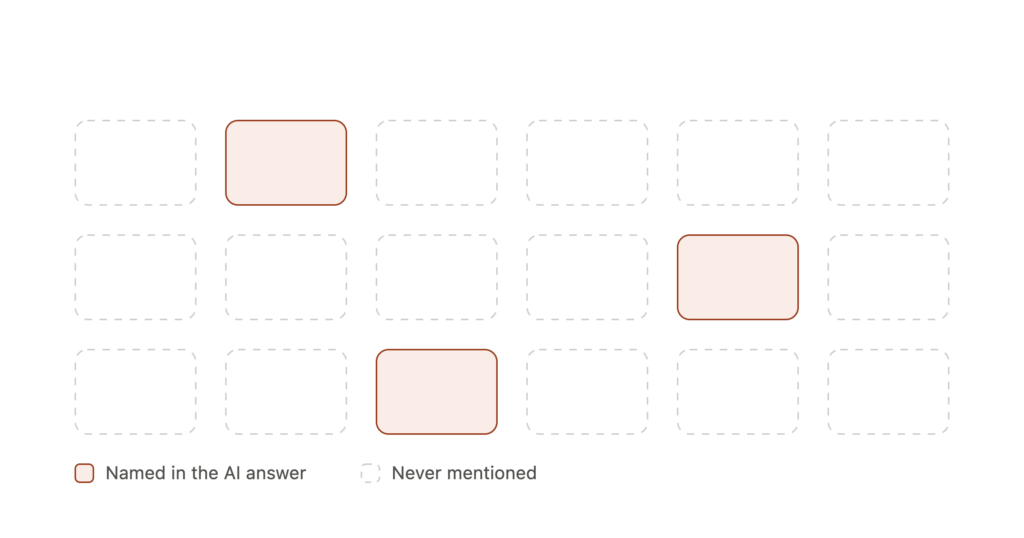
A clinic owner in Bilaspur recently learned something uncomfortable from a patient. The patient had asked an AI assistant to suggest a good dentist nearby. It named three. His clinic, which has run for eleven years and sits on the first page of Google for the same search, was not one of them.
Nothing had gone wrong with his website. The question simply never reached it.
That gap is becoming the quiet problem of Indian digital commerce. For two decades the rule was simple. Rank on Google, get found. Now a growing share of searches end inside an AI generated answer that summarises the web and names a handful of sources. Everyone else is invisible, regardless of rank.
The numbers behind the shift are no longer small. SparkToro research found that 68% of Google searches in the United States ended without any click in early 2026, up from around 60% two years earlier. Ahrefs reported that when an AI summary appears at the top of a results page, clicks on the leading result fall by close to 58%. Pew Research Center found roughly 26% of searches showing an AI summary end with the user leaving entirely, against 16% when no summary appears.
India is not watching this from a distance. Sensor Tower data shows India became the world’s largest market for generative AI app downloads in 2025, with installs up 207% in a year. OpenAI has said India is its second biggest market by weekly users, and Google has extended its AI search mode into Hindi and seven other Indian languages. The person asking an AI assistant for a tailor, a tuition centre or a travel package is increasingly an ordinary small town user, not a metro professional.
Rankora, a search visibility platform founded by Shiva Roy and run from Bilaspur and Raipur, was built around this blind spot. Its live platform sits at rankorra.com. Rather than tracking only keyword positions, it checks whether a business is being cited inside AI generated answers, and scores how usable its pages are as a source in the first place.
“Most owners think the problem is money, that some competitor outspent them on ads,” said Roy. “The real problem is that the information about their business is scattered, inconsistent or written in a way no machine can confidently repeat. An AI system will not recommend what it cannot verify.”
The economics of being named are stark. Analysis by Seer Interactive found a page cited inside an AI summary earns roughly 2.1% click through rate, while an uncited page on the same results page earns about 0.9%. Both sit below the roughly 3.3% that the same searches delivered before AI summaries existed. Everyone lost ground. The difference between being cited and being skipped is still more than double.
Small businesses are unusually exposed here, for reasons that have nothing to do with budget. Their address appears three different ways across listings. Their service pages are written as marketing copy with no plain factual answers. They have no structured data on their site telling a machine what they do, where they are and what they charge. All of this was survivable when a human was doing the reading. It is not survivable when a model is deciding who to cite.
The company is also reducing its dependence on outside data. From this month Rankora has begun building its own crawling infrastructure for backlinks and domain authority, with the aim of running its own data model rather than licensing one from a foreign provider.
Roy is careful about what the category can promise, which is unusual in a field now crowded with agencies selling guaranteed placement inside AI chat results.
“Nobody can promise you a place inside an AI answer, and anyone promising that is selling a lottery ticket,” he said. “What can be delivered is a clear measurement of where you stand, a fix list in plain language, and proof that AI crawlers are actually reading your pages. That is slow work. It is also the only honest version of it.”
The limits are real. A large share of what AI systems say about a business comes from sources the business does not control, including directories, reviews and forum posts. Citation behaviour differs between platforms and changes without notice, which makes any measurement directional rather than exact.
For now the advice for a local owner is less technical than it sounds. Make the basic facts about the business consistent everywhere they appear, answer real customer questions in plain language on the website, and stop assuming that a good ranking means the phone will ring.


Leave a Reply