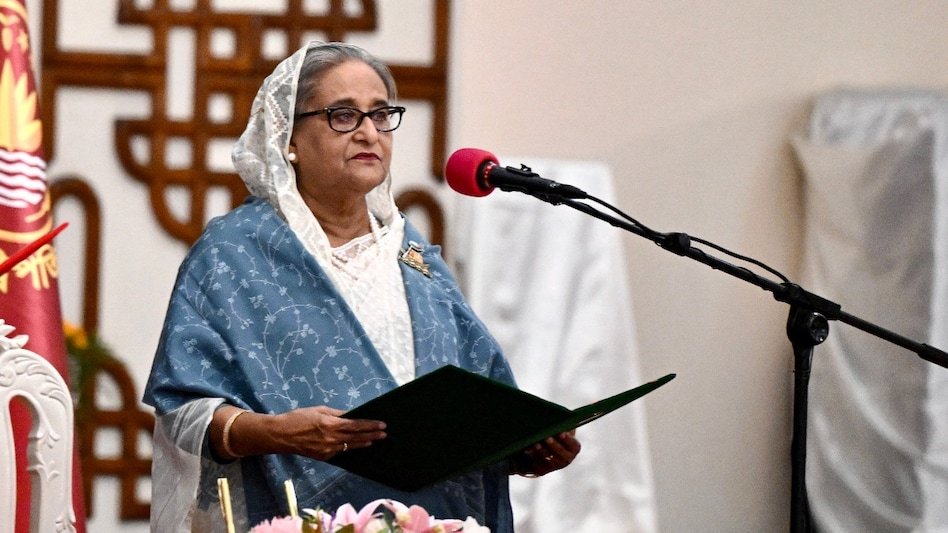
Bangladesh’s law minister said Saturday that Dhaka has completed every legal step needed to seek Sheikh Hasina’s return from India, and that the decision now rests with New Delhi. India’s foreign ministry has acknowledged Bangladesh’s extradition request but has not set a timeline for responding to it.
What Bangladesh’s Law Minister Said
Law Minister Md Asaduzzaman told reporters that Bangladesh’s side of the process is finished and that any further step depends on India, according to a PTI report carried by Business Today. He said Hasina’s return would go through legal channels under the 2013 India-Bangladesh extradition treaty.
Bangladesh has pursued Hasina’s extradition since she fled to India in August 2024 following her government’s collapse. Dhaka’s interim administration has sent repeated formal requests to New Delhi since, with no extradition decision announced so far.
How the Case Has Unfolded
Bangladesh’s International Crimes Tribunal convicted Hasina in November 2025 and sentenced her to death. Her former home minister, Asaduzzaman Khan Kamal, received the same sentence in the same verdict, while a former police chief who turned state witness, Chowdhury Abdullah Al-Mamun, was given five years, according to a Tribune India report citing Bangladesh’s United News of Bangladesh agency.
After the verdict, Bangladesh’s interim government sent a formal note to New Delhi renewing its extradition request, which Foreign Affairs Adviser Touhid Hossain confirmed at the time. Dhaka’s foreign ministry called it “a grave act of unfriendly conduct” for any country to shelter a person convicted under the tribunal’s law, citing India’s obligations under the bilateral extradition treaty. India’s foreign ministry acknowledged the verdict then but did not address the extradition question directly.
That note was the third official extradition request Bangladesh had sent since Hasina fled, according to Dawn, citing Bangladeshi daily Prothom Alo. The charges against her stem from a 2024 crackdown on protesters that the United Nations has said killed up to 1,400 people. Bangladesh’s National Security Adviser, Khalilur Rahman, has separately met his Indian counterpart, Ajit Doval, on the sidelines of a regional security summit, though neither side has described Hasina’s case as a formal agenda item at that meeting.
India’s Response So Far
Ministry of External Affairs spokesperson Randhir Jaiswal confirmed that India has received Bangladesh’s extradition requests but said no decision has been made. Jaiswal said the matter is legal in nature and would be handled accordingly, adding that India wants a positive, constructive and forward-looking relationship with Bangladesh.
India’s foreign ministry has separately said any return would require Hasina to hold a valid travel document, and that questions about her passport application are better directed to Bangladesh’s own mission in New Delhi, according to The Wire. Jaiswal has not given a timeline for when, or whether, the travel document question will be resolved.
Bangladesh has separately linked progress on the extradition question to a possible visit to India by Prime Minister Tarique Rahman, though no date for such a visit has been confirmed.
Why Hasina Cannot Appeal Her Sentence
Bangladesh’s International Crimes Tribunal convicted Hasina in absentia in November 2025 on charges of crimes against humanity tied to a 2024 crackdown on protesters, sentencing her to death on one charge and life imprisonment on another. Asaduzzaman said the law under which she was tried allows her no right of appeal against the verdict.
Hasina, 79, has rejected the charges against her. She announced plans in August to return to Bangladesh by December during an audio-only press conference held in New Delhi, a call that Dhaka objected to and that India described as a private matter.
The Stalled Passport Request
Hasina has approached the Bangladesh High Commission in New Delhi through a London-based legal chamber seeking a new passport and national identity card, according to the same report. Bangladeshi authorities said the applications are still being examined, with no outcome announced yet.
Without a valid Bangladeshi passport, Hasina cannot travel internationally on her own, which is why India’s foreign ministry has pointed to the travel-document question as a practical hurdle separate from the extradition request itself. Dhaka has not said how it would respond if the passport application is rejected.
Frequently Asked Questions
Can Sheikh Hasina appeal her death sentence?
No. Bangladesh’s law minister said the law governing her trial at the International Crimes Tribunal does not allow an appeal against the verdict.
What does the India-Bangladesh extradition treaty require?
Signed in 2013, it provides for the return of people charged with, convicted of, or wanted to serve a judicially imposed sentence, though it allows either country to refuse a request involving an offence that is political in nature.
What Happens Next
The extradition request remains with New Delhi, which has given no public timeline for a decision. Whether Hasina’s passport and identity-card request is granted, and whether a Rahman visit to India materialises, are the two developments most likely to move this forward.

Leave a Reply