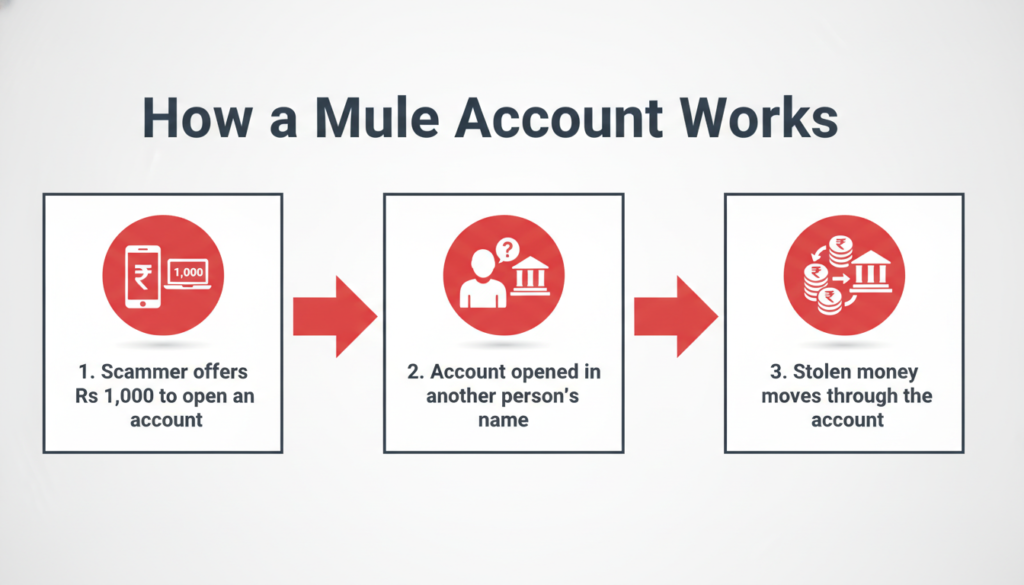
Surajpur district police have arrested a 54 year old man in a mule account fraud case, accused of opening fake bank accounts for Rs 1,000 a piece and handing them to cybercriminals, who used them to move Rs 14,17,049 in fraud proceeds across several states. He was sent to jail on Wednesday after being charged under three sections of the Bharatiya Nyaya Sanhita.
The accused, Satish Kumar Bharti, is a resident of Dwarikanagar village under the Latori police post in Surajpur district, according to Patrika. He was arrested and sent to judicial custody by Surajpur Kotwali police.
Investigators said the case surfaced after instructions from Police Headquarters in Raipur, acting on data from the Indian Cyber Crime Coordination Centre’s citizen complaint portal. That portal had logged online fraud complaints from several states, all tracing back to a single bank account linked to Bharti.
How the mule account scheme worked
Bharti got in touch with a contact through Facebook who offered Rs 1,000 for every bank account he could arrange in someone else’s name, per Patrika’s reporting. He then had accounts opened at Punjab National Bank and linked them to mobile numbers he controlled.
Once opened, the accounts functioned as what investigators call mule accounts, passthrough accounts used to receive and move money from online fraud without the account holder’s name being directly tied to the scam. Cybercriminals operating in multiple states allegedly routed fraud proceeds through the accounts Bharti arranged, totalling Rs 14,17,049.
How police traced him
The trail began with the Indian Cyber Crime Coordination Centre’s portal, which aggregates complaints filed by fraud victims nationwide. Police headquarters in Raipur flagged the pattern of complaints tied to the account to Surajpur’s Kotwali police, who opened an investigation.
Kotwali police then detained and questioned Bharti, and he admitted his role in arranging the account for the Facebook contact in exchange for the payment, Patrika reported. The report does not specify how long the investigation took between the portal flag and the arrest.
What charges he faces
Kotwali police registered the case under Sections 318(4), 317(4), and 3(5) of the Bharatiya Nyaya Sanhita, which cover cheating and acting with common intent in the commission of an offence. Bharti was arrested and sent to jail on Wednesday, October 28.
Patrika’s report does not name the Facebook contact Bharti said he dealt with, or say whether that person or any of the eventual cybercriminals who used the account have been identified or arrested separately.
Why this matters for Chhattisgarh residents
Mule accounts are a recurring problem for Chhattisgarh’s cyber cells, since small, cash based offers to open an account are an easy way for fraud networks operating from outside the state to find passthrough channels for stolen money. Cases like this one typically surface only after a victim elsewhere in India files a complaint and the trail is worked backward to the account holder in the state.
Anyone who agrees to open a bank account for payment and hand over the passbook, debit card, or online banking access to another person risks being treated as a suspect in whatever fraud that account is later used for, regardless of whether they personally scammed anyone. Once a complaint is logged on the Indian Cyber Crime Coordination Centre’s portal, the Centre’s data sharing with state police headquarters is what connects a victim’s complaint in one state to an account holder in another, which is the same mechanism that led Raipur police headquarters to flag Bharti’s account to Surajpur’s Kotwali police in this case.
That data sharing model means an account opened quietly in a small Surajpur village can be the final link traced back from a fraud complaint filed hundreds of kilometres away, often weeks or months after the account itself was opened.
Frequently asked questions
What is a mule account?
A mule account is a bank account opened in one person’s name but controlled or used by another, usually to receive and move money from fraud without directly exposing the fraudster’s own identity. The account holder is often paid a small, one time sum, as Bharti was allegedly paid Rs 1,000 per account, per Patrika’s report.
Can someone be arrested just for lending their bank account?
Yes. Investigators treat account holders who knowingly hand over control of their account as participants in the fraud, not bystanders. In this case, Kotwali police registered the case against Bharti himself under Sections 318(4), 317(4), and 3(5) of the Bharatiya Nyaya Sanhita, the sections covering cheating and acting with common intent.
Where can Chhattisgarh residents report a suspected cyber fraud or mule account offer?
The national helpline number 1930 and the Indian Cyber Crime Coordination Centre’s online portal, cybercrime.gov.in, are the official channels for reporting financial cyber fraud anywhere in India, including Chhattisgarh.
What happens next
Surajpur Kotwali police said further action is underway based on the information gathered so far, per Patrika’s report. That leaves open whether investigators will trace the funds to specific victims, identify the Facebook contact who recruited Bharti, or find others involved in the wider network that used his account.

Leave a Reply